
Semantic Cocoon & Netlinking: the ultimate combo to boost your SEO
SEO has changed dramatically in recent years. Google no longer simply analyses keywords or indexes pages mechanically. The search engine now tries to understand a topic as a whole, to gauge how relevant a piece of content is and to assess how consistent a site is overall.
It is precisely in this context that the semantic cocoon has become an essential approach for structuring a website, reinforcing how your content is understood and maximising its organic potential.
And when it is paired with a solid netlinking strategy, it becomes one of the most powerful levers for achieving durable, stable and high-performing search rankings.
In this article:
Understanding the semantic cocoon: an architecture built for relevance
The semantic cocoon rests on a simple principle: organise a website around a central theme, then develop that theme through logical, interconnected hierarchical levels.
In practical terms, a main page covers the broad subject, while secondary pages dig deeper into specific sub-questions. Each piece of content reinforces the others, creating a genuine editorial ecosystem that gives Google a clear, structured and consistent view of the topic covered.
What makes the cocoon so powerful is not only the richness of its content, but also the logic of its internal linking. Links are not placed at random: they follow an intention, a progression, a hierarchy. This organisation lets value flow between pages and channels power towards those that need to perform first.
It is a way of “steering” your SEO from the inside while considerably improving navigation for the user, who is offered a smart and intuitive journey.
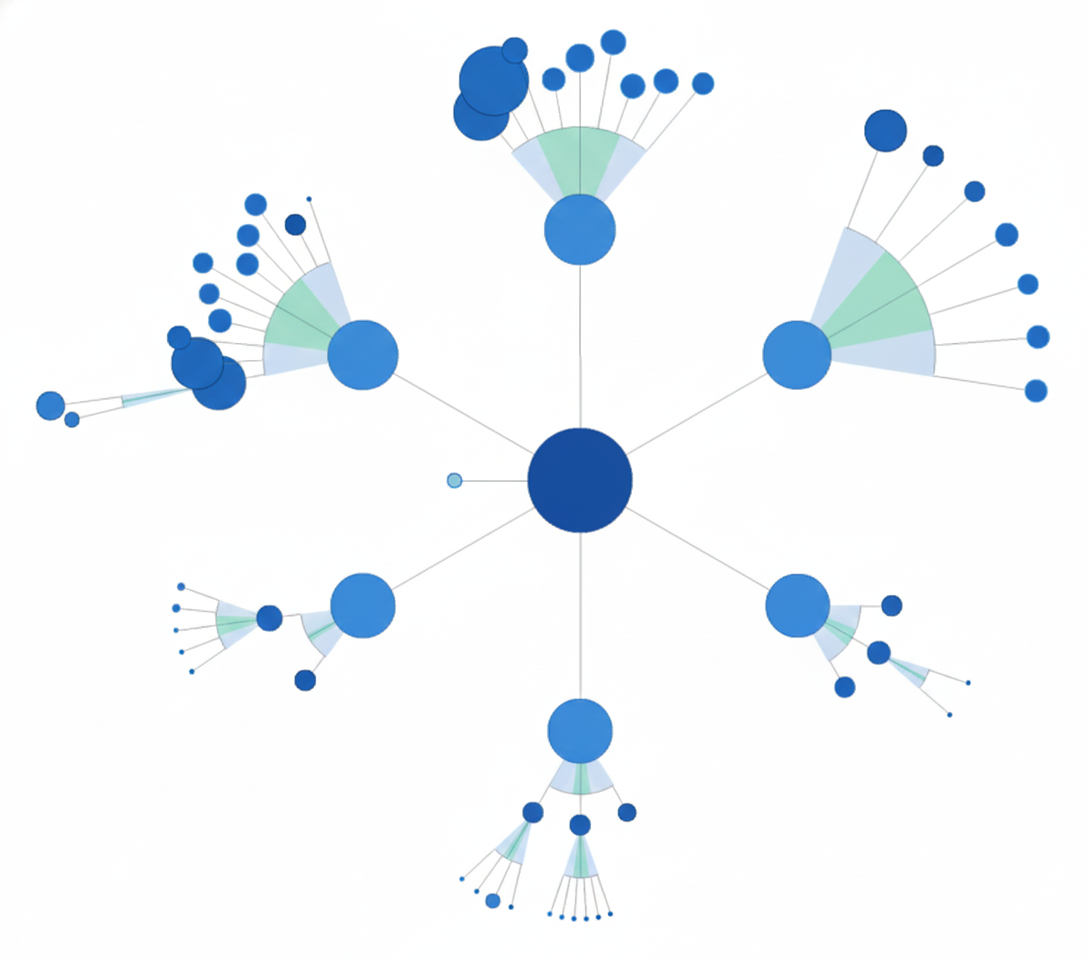
Image – Cocon.se
Why is the semantic cocoon so effective for SEO?
When you structure your content into a cocoon, you create the kind of environment Google loves: rich, precise, complete and well organised. The search engine immediately understands which topics you master, which pages matter most and how they connect to one another.
This deeper understanding generally translates into:
- faster progress on strategic keywords,
- better rankings on long-tail queries,
- easier indexing,
- more positive user signals (time on page, smooth navigation),
- stronger topical authority.
More and more sites are finding that this type of architecture allows them to move up a level in terms of visibility and stability, because the very structure of the cocoon delivers a depth rarely achieved with a simple blog or a series of standalone articles.

How to build a high-performing semantic cocoon?
Everything starts with a clear intention. You choose a main subject, a business or commercial theme, then map out all of its sub-topics and related questions.
This strategic step is crucial: it determines the overall consistency of the structure.
Next comes semantic research: understanding what Google expects, what users are looking for and how the various intents break down. With this in hand, you can design a logical, high-performing tree structure.
The writing must then deliver value, depth and precision. A cocoon is not a pile of texts: it is a deliberate editorial construction in which every page plays a role in the wider ecosystem. Once the content is in place, internal linking brings the cocoon to life, guides the user and passes semantic power between pages.
Finally, this structure must be technically sound: optimised titles, clean URLs, a clear structure and optimised loading speed. A high-performing cocoon is the result of holistic work, where editorial strategy, SEO optimisation and user experience move forward together.
The semantic cocoon is not enough: the essential role of netlinking
Even the best-built cocoon cannot reach its full potential without a genuine netlinking strategy.
The cocoon strengthens your site from the inside, while backlinks show Google that third-party sites consider your content relevant, credible and worth ranking.
The cocoon + netlinking pairing is formidable, because each amplifies the other. Backlinks pointing to the pillar page considerably strengthen its authority, and internal linking spreads that power throughout the cocoon.
The result is often spectacular: pages that climb quickly, positions that stabilise and overall visibility that grows sustainably.
This is exactly where MisterGoodLink becomes a strategic partner. The platform lets you obtain thematically relevant backlinks, published on quality sites, with no middleman and with full control over your budget. Within a semantic cocoon, this thematic consistency is a major asset: each link reinforces the editorial universe you have built.
Common mistakes and what real-world feedback teaches us
Cocoons that fail often share the same flaws: content that is too shallow, sloppy internal linking, or an architecture so complex that it helps neither the user nor Google.
Others simply forget to work on netlinking, assuming the cocoon is enough on its own. In reality, the cocoon is a foundation; netlinking is what provides the propulsion.
Sites that adopt a holistic approach — semantic structure, rich content, consistent internal linking, gradual netlinking — get the best results. The gains are often visible within the first few weeks and build up over time.
The winning combination for powerful SEO
The semantic cocoon is far more than a technique: it is a genuine philosophy of editorial and SEO structuring. It brings clarity, depth and consistency to your site. But it is when paired with a well-managed netlinking strategy that it reveals its full potential.
For businesses looking to build solid, durable and scalable visibility, the cocoon + netlinking duo is today the most effective approach.
And if you want to give your cocoon more power, MisterGoodLink supports you with a selection of thematic, reliable sites and no middleman commission — a perfect solution for strengthening your authority while keeping control of your budget.


