
Domain Authority: understand and optimise this key SEO metric

When you analyse a site before building an SEO strategy or a link campaign, Domain Authority is one of the metrics you keep coming across. Usually shortened to DA, it estimates the overall strength of a domain’s SEO profile. One caveat: Domain Authority is not a score assigned by Google, and a high DA does not automatically mean better rankings. DA is best treated as a comparative indicator. It helps you size up competitors, review referring domains and pick sites that fit a backlink strategy. How is Domain Authority calculated? What counts as a good score? How does it differ from Domain Rating or Trust Flow? And, above all, how do you raise a domain’s authority over time? Here is what matters.
In this article:
What is Domain Authority?
Domain Authority is an SEO metric developed by Moz. It gives a domain a score between 1 and 100. The aim is to estimate how likely a domain is to rank in search engines, mainly from features of its link profile. The closer the score is to 100, the stronger the authority profile usually looks in Moz’s data and model. Two things still need to stay separate:
- Moz Domain Authority, a metric created by an SEO tool;
- the signals Google actually uses to rank pages.
Google does not take Moz’s DA score and use it to rank a page. The engine has its own systems, including several ways of evaluating links between pages. DA is useful for comparisons. It is not an exact picture of Google’s algorithm.
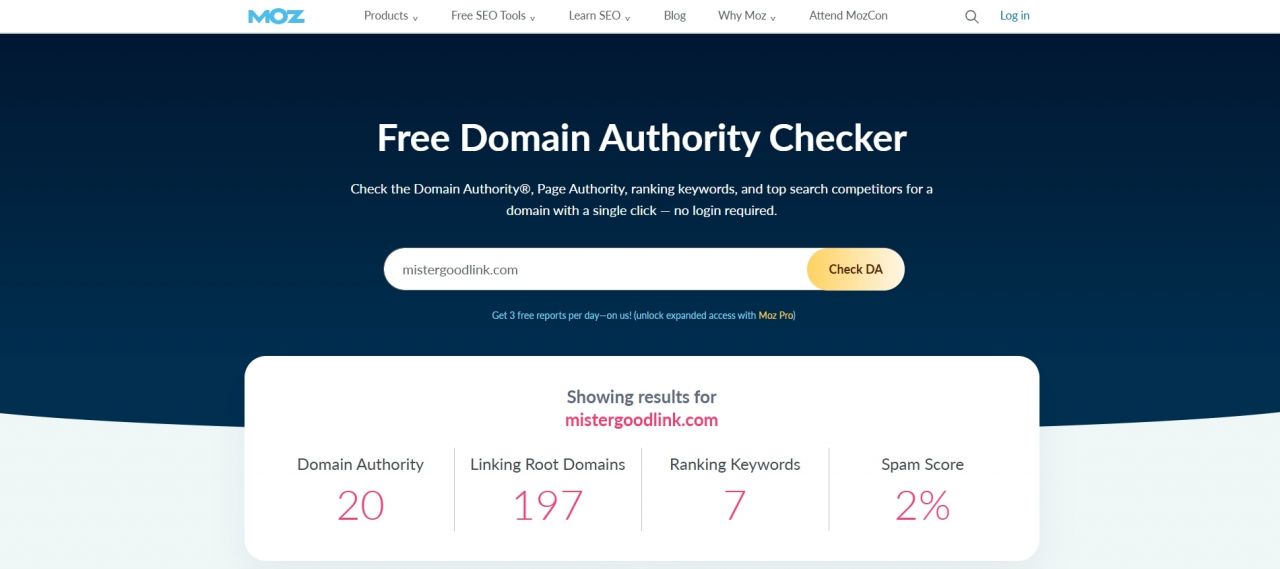
How is Domain Authority calculated?
The precise calculation belongs to Moz and can change over time. It draws on data from Moz’s link index and on a model built to make domains comparable. Authority tools typically look at things such as:
- the number of referring domains;
- the number and nature of backlinks;
- the authority of the sites behind those links;
- the overall shape of the link profile;
- how authority is spread across the site’s pages.
The score is meant to be read relatively. Comparing two sites in the same niche is usually more useful than comparing unrelated domains. A specialist site can sit well below a national publisher on DA and still rank strongly for the queries that matter in its field.
What is a good Domain Authority?
There is no universal line between a good DA and a bad one. It depends on the sector, the competition and how mature the domain is. A new site in a small niche should not be compared with Wikipedia, a major publisher or an international marketplace sitting on millions of backlinks. The practical way to read your DA is to pick several real SEO competitors and look at:
- their Domain Authority;
- their number of referring domains;
- their estimated organic traffic;
- the quality of their backlinks;
- their best-ranking pages;
- how topically relevant their links are.
A DA of 25 can be strong in a niche where most competitors sit around 15 to 20. The same score can look weak on a results page dominated by domains with much higher authority metrics.
Does Domain Authority directly affect Google rankings?
No. Domain Authority is not a ranking factor Google uses directly. That is one of the main mistakes people make with this metric. A rise in DA does not mean Google will move all of your pages up. Domain Authority does, however, rest partly on traits that go with a solid SEO strategy, especially earning external links. Search engines use links between pages to understand the web and to spot content that may be useful. Google says link-analysis systems, including PageRank, remain part of its core systems. A strategy that earns real editorial backlinks from relevant sites can improve the metrics SEO tools report and, more broadly, support organic visibility.
Why monitor Domain Authority?
Even though it is not a Google metric, tracking DA still has a few uses.
Compare your site with competitors
Domain Authority gives a quick sense of how domains compare in relative strength. If your main competitors consistently show much richer link profiles, the gap is often one of external popularity.
Track how the link profile evolves
A steady rise in DA can accompany a growing backlink profile. The goal is not to push the metric for its own sake. The real aim is relevant links that support SEO visibility and the domain’s reputation.
Assess backlink opportunities
DA can also be a first filter when you look at a site where you might earn a backlink. It should never be the only filter. A high-DA domain can have lost most of its traffic, publish across dozens of unrelated topics, or carry an unnatural link profile. Conversely, a mid-DA site with a clear topical focus, real traffic and solid content can be an excellent opportunity.
Domain Authority, Domain Rating and Trust Flow: what is the difference?
Several SEO tools have built their own metrics to make domain analysis easier.
| Metric | Tool | Main use |
|---|---|---|
| Domain Authority (DA) | Moz | Estimate a domain’s relative authority |
| Domain Rating (DR) | Ahrefs | Estimate the strength of the backlink profile |
| Trust Flow (TF) | Majestic | Estimate the trust associated with the link profile |
| Citation Flow (CF) | Majestic | Measure strength tied to link volume |
| Referring domains (RD) | Several tools | Count distinct domains that link |
These figures should not be compared as if they were the same scale. A DA of 40 is not necessarily a DR of 40 or a Trust Flow of 40. Each provider uses its own database and its own method. To read a domain properly, cross several signals rather than hunting for a single magic number.

How do you increase Domain Authority?
There is no button that raises a domain’s authority overnight. A lasting increase usually comes from developing the site and its link profile over time.
1. Earn backlinks from new referring domains
Hundreds of links from a single site do not mean the same thing as recommendations from many independent sites. Growing the number of relevant referring domains is a core part of a link-building strategy. Favour links from:
- sites in your sector;
- specialist media and blogs;
- professional partners;
- sites with a real audience;
- pages that already have some visibility.
2. Prefer relevance over the highest DA
Always picking the domain with the highest DA is rarely enough. Imagine a gardening site. A backlink from a publisher covering homes, outdoors or garden design has an obvious editorial fit. A link from a higher-metric domain about a completely different subject is much harder to justify in context. When you choose a backlink, always look at the topical proximity between the two sites.
3. Look at the source site’s traffic
A strong authority score does not mean the domain still has a meaningful SEO audience. Before you acquire a link, also check:
- how organic traffic is trending;
- how many keywords the site ranks for;
- whether some pages actually receive traffic;
- whether it publishes regularly;
- whether the site is still being indexed.
The combination of authority, traffic and topical relevance is usually a much better picture than any metric on its own.
4. Create content that naturally deserves links
Link building is not only outreach or sponsored articles. Some pieces are simply easier to cite. That includes:
- original studies;
- industry statistics;
- detailed comparisons;
- free tools;
- calculators;
- infographics;
- in-depth guides;
- proprietary data.
These can become real linkable assets: resources other sites have a reason to reference.
5. Strengthen internal linking
Authority earned through backlinks then has to move between the site’s pages. That is the point of internal linking. A clear structure connects important content with deeper pages. Avoid important pages that take many clicks to reach, and add contextual internal links from pages that already have visibility.
6. Recover unlinked brand mentions
Your company or site can be mentioned online without a link. Those mentions are particularly useful: the publisher already knows the brand and already has the context to add a link. Find the mentions, then ask the site owners to link to the matching page or resource.
7. Analyse competitors’ backlinks
Competitive analysis shows which domains already link to several players in your market. Look in particular for:
- media that cite your competitors;
- specialist sites in your sector;
- comparison articles;
- partners and professional associations;
- resources that get cited often.
You end up with a prospect list whose topical fit is already partly proven.
8. Diversify the link profile over time
A durable link strategy should not rest on one type of site, one anchor or one acquisition method. A natural profile can mix:
- brand links;
- naked URLs;
- topical anchors;
- editorial links;
- media citations;
- links to the homepage;
- links to articles and deep pages.
Diversity still has to match the business and the way a site would normally be cited on the web.
Should you remove bad backlinks to raise DA?
Mediocre backlinks do not mean you should try to delete every suspicious link. Many sites naturally receive links from domains of mixed quality. Before you act, separate:
- a link that is merely weak or useless;
- an artificial link built to manipulate rankings;
- a large volume of clearly problematic links.
The main job is usually to strengthen the overall profile with better referring domains, not to spend all your time chasing a perfectly clean profile according to a third-party metric.
How do you choose a backlink without relying only on Domain Authority?
DA is handy for a first pass. A decision needs several criteria. A simple checklist:
- Topic: does the site fit your business?
- Traffic: is there an identifiable organic audience?
- Referring domains: does the link profile look developed and varied?
- Trust Flow: do the trust signals look sound?
- Content: are the articles actually worked on?
- Indexing: do new pages show up in Google?
- History: does the domain look stable over time?
- Link placement: will the backlink sit naturally in relevant content?
That is why a link platform should not stop at a single score. With MisterGoodLink, you can search backlink opportunities and compare signals such as traffic, Trust Flow, Citation Flow and referring domains, then pick sites that fit the strategy.
Domain Authority or backlink quality: which comes first?
Backlink quality should come before chasing the highest DA. A good link is, above all, a link that is:
- placed on a relevant site;
- set inside coherent content;
- coming from a properly indexed page;
- issued by an active domain;
- likely to be useful to readers.
Domain Authority can complete that reading. It should not replace it. This avoids picking sites only because a metric looks impressive while traffic, content or editorial fit has already slipped.
How long does it take to increase Domain Authority?
There is no universal delay. Movement depends on:
- where the domain starts;
- how fast new referring domains are earned;
- how strong those backlinks are;
- how often the tools discover the links;
- how other domains in their index evolve.
Because Domain Authority is comparative, the score can move even when you have not changed the site. Read the trend over several months rather than watching a few points every day.
Which metrics should you track alongside DA?
For a useful view of SEO, complete Domain Authority with indicators tied to the site’s actual performance. You can track:
- organic traffic;
- clicks and impressions in Google Search Console;
- rankings for strategic keywords;
- the number of indexed pages;
- the number of referring domains;
- new backlinks earned;
- the traffic of domains that link to you;
- Trust Flow and Citation Flow;
- conversions from organic search.
Those figures show whether a gain in authority is actually matched by better SEO performance.
Is Domain Authority still useful in SEO?
Yes, as long as you know what it measures and, just as importantly, what it does not. Domain Authority is a strong comparison indicator. It places a domain quickly, tracks some changes and makes a first cut among backlink opportunities. It should never become the main goal of an SEO strategy. Moving a DA from 30 to 40 matters little if organic traffic falls and the strategic pages do not progress. The goal remains a site that is useful, visible and recognised in its topic. The same rule applies to link building: always cross authority with relevance, traffic, referring domains and the real quality of the site. Want an easier way to find sites that fit the campaign? The MisterGoodLink catalogue lets you compare opportunities across several SEO metrics and build a more varied backlink profile over time.
Domain Authority FAQ
What is Domain Authority in SEO?
Domain Authority, or DA, is a Moz metric that scores domains from 1 to 100. It is mainly used to compare the relative authority of different sites, especially from their link profiles.
Does Google use Domain Authority?
No. Domain Authority is a metric created by Moz, and Google does not use it directly in its ranking algorithm. Google has its own systems and signals for analysing pages and links.
What Domain Authority do you need to rank well?
There is no minimum score. DA should be compared with other sites in your sector. A domain with a relatively low DA can still outrank a higher-scoring site if its page answers the query better.
How do you increase Domain Authority quickly?
There is no reliable way to raise DA instantly and durably. New high-quality referring domains, content that can earn links, and a coherent link strategy usually strengthen domain authority over time.
What is the difference between Domain Authority and Domain Rating?
Domain Authority is a Moz metric, while Domain Rating comes from Ahrefs. Both assess aspects of a domain’s authority, but their data and methods differ. The scores are not directly comparable.
Is a backlink from a high-DA site always a good one?
No. DA is only one criterion. You also need the site’s topic, its traffic, its referring-domain profile, its content, its indexing and the context in which the backlink will sit.


