How to build a netlinking strategy in 5 steps?
Before starting anything on the netlinking side, there is a hugely important prerequisite to respect: on your website, every page must be well optimised for a specific keyword. That way you don't have two pages likely to rank for the same keyword in the SERPs. This means that on each page you have used vocabulary that corresponds specifically and exclusively to one topic, trying not to reuse vocabulary that could serve to write about another subject.
In this article:
Step 1: choose your vocabulary

So we have different types of keywords in our hands. Now the goal is to do netlinking in a precise way: each page must receive backlinks that correspond to it, to it and to no other page on the site. The harder you work to respect this rule, the more your netlinking strategy will pay off.
So for each backlink, you need to identify the vocabulary of the topic of the page targeted by the backlink.
Step 2: write a text using that vocabulary

To write a text that kicks off your netlinking strategy, you absolutely must use the same vocabulary. It has to be an original text, though: never copy and paste!!! If needed, you can call on freelance copywriters whose job is precisely to write this type of content.

Step 3: find a website matching the topic
The text, which you wrote or had written by a professional whose expertise this is, must now be published on a website other than your own. So you need to find a site that covers the same topic – that is, a site made up of pages with texts written using the same vocabulary.
Step 4: publish the text and choose the link anchor

Now that we have everything we need to get off to a good start, all that's left is to publish your first text. You'll place a backlink in it that will send whoever clicks on it to the page on your site. There you'll have to carefully choose an anchor for that link, that is, a series of words that will be underlined and will signal to the reader that they are invited to click. You have several options for this anchor:
- a few words surrounding the keyword that defines the destination page,
- an expression containing a synonym of that keyword,
- a short sentence – 5 to 7 words – explaining what is at the end of the link,
- the name of the site the link points to,
- the URL of the page targeted by the link.
Step 5: grow your strategy
You have kicked off your netlinking strategy. Good. Now you need to keep going. To do so, you should always keep the same logic of action:
- choose your vocabulary
- write a text using that vocabulary
- find a website matching the topic
- publish the text and choose the link anchor
For everything to work beautifully, you will need to multiply the number of links, like this:
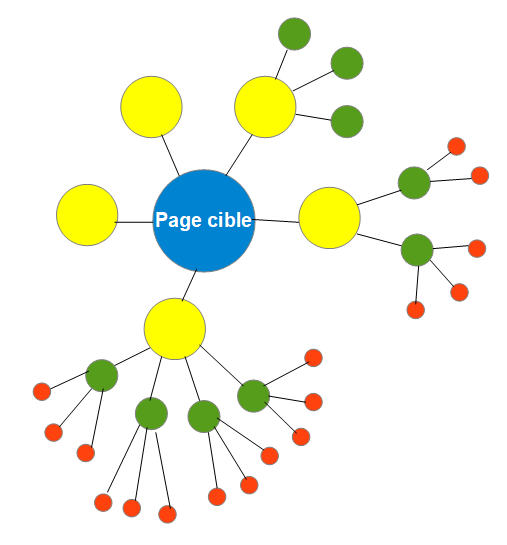
- a series of texts containing links (1st circle, in yellow) pointing to the page on your site
- a series of texts containing links (2nd circle, in green) pointing to the 1st circle
- a series of texts containing links (3rd circle, in red) pointing to the 2nd circle
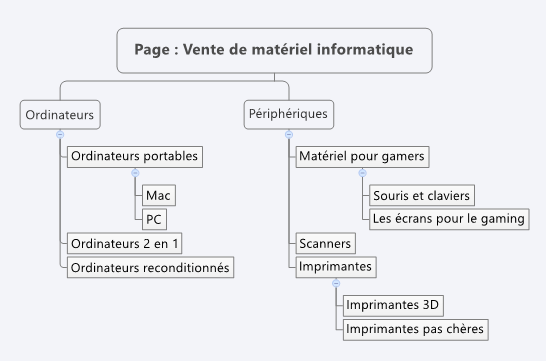
You don't always have to write texts on one single topic: there are always themes that are close to that of the target page.
Here are a few examples:
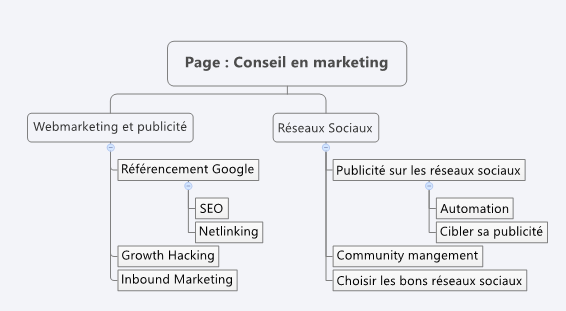
Target page topic: marketing consulting
Target page topic: selling computer hardware
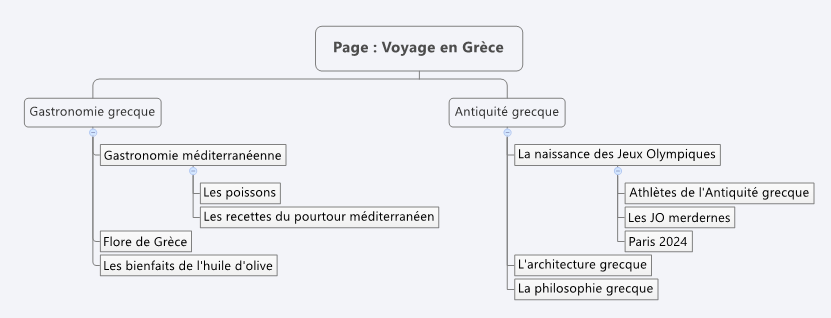
Target page topic: travel in Greece